E-commerce Analytics Platform on Snowflake
Project Overview
This project involved designing and implementing a scalable, cloud-native e-commerce analytics platform using Snowflake on AWS.
The solution centralized data from transactional systems, application logs, and event streams to enable reliable analytics, reporting, and business intelligence for stakeholders.
The architecture supports both batch and near real-time data ingestion, modular transformations, and governed analytics-ready datasets for BI consumption.
Business Context
The e-commerce platform generated high-volume data from multiple operational sources, including transactional databases, application logs, and web/application events. Business teams required a unified analytics solution to:
- Consolidate data across disparate systems.
- Enable reliable reporting and dashboards.
- Support analytics across multiple business domains.
- Scale with increasing data volume and complexity.
The existing data landscape lacked a centralized, scalable analytics foundation.
Business Problem
Data was fragmented across multiple systems with no unified analytics layer.
Reporting relied on manual processes, data latency was high, and there was no scalable mechanism to support consistent business intelligence across teams.
Key Challanges
- Data distributed across multiple source systems.
- High-volume log and event data requiring streaming ingestion.
- Need for scalable and maintainable data transformations.
- Ensuring analytics-ready data for BI tools.
- Orchestrating batch and streaming workflows reliably.
Solution Architecture
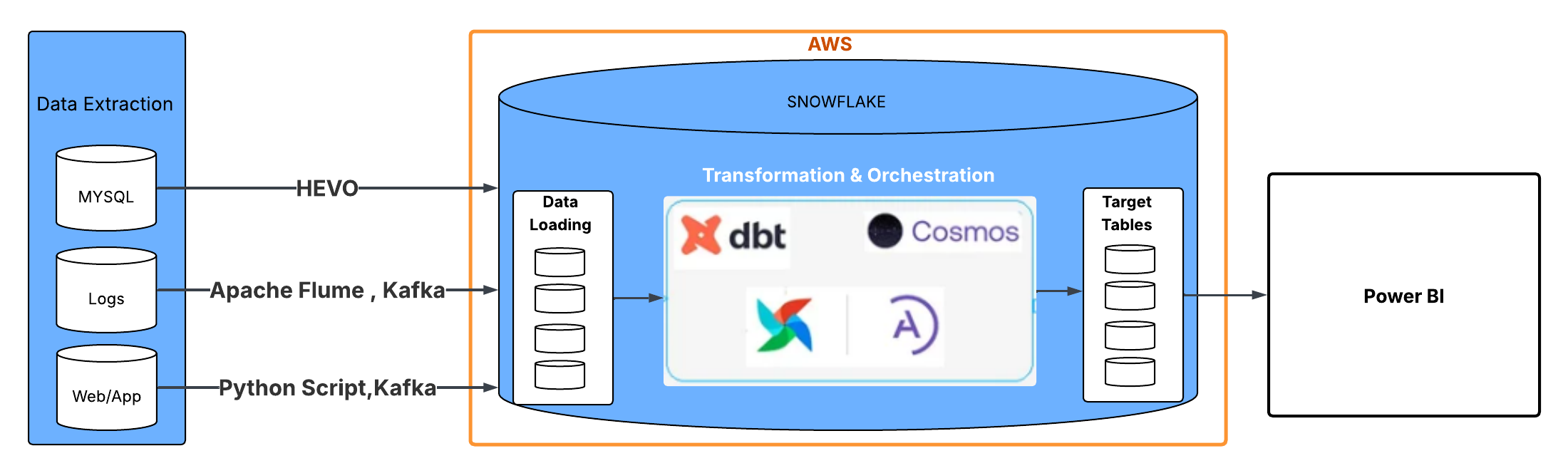
I designed an end-to-end data architecture centered around Snowflake on AWS, as illustrated in the project diagram.
Data Sources & Ingestion
Transactional Data- Extracted from MySQL using Hevo.
- Automated ingestion into Snowflake staging layers.
- Application and system logs ingested using Apache Flume and Kafka.
- Web and application events streamed via Python scripts and Kafka.
This approach enabled both batch ingestion and streaming pipelines to coexist within the same platform.
Data Platform (Snowflake on AWS)
- Snowflake served as the centralized analytics warehouse.
- Snowflake served as the centralized analytics warehouse.
- Designed for scalability, elasticity, and analytical performance.
Transformation & Orchestration
Transformation & Orchestration- dbt used for data modeling and transformations.
- Modular, reusable models implemented for maintainability.
- Business logic applied consistently across datasets.
- Apache Airflow used to orchestrate ingestion and transformation workflows
- Managed task dependencies and scheduling across pipelines.
Managed task dependencies and scheduling across pipelines.
Analytics & Reporting
- Curated target tables exposed to Power BI.
- Business-friendly datasets designed for reporting and dashboards.
- Enabled analytics across sales, customer behavior, and operational metrics.
Outcome & Impact
- A unified, cloud-native analytics platform for e-commerce data.
- Scalable ingestion for transactional, log, and event data.
- Reliable, analytics-ready datasets for BI and reporting.
- Improved visibility into business and operational performance.
- A foundation for future analytics and data-driven initiatives.
Technologies Used
- Snowflake
- AWS
- dbt
- Apache Airflow
- Apache Kafka
- Apache Flume
- Python
- MySQL
My Role
- Architecture design.
- Data ingestion strategy.
- Data modeling and transformations.
- Workflow orchestration.
- End-to-end platform implementation.
Key Takeaway
This project demonstrates how a Snowflake-centric, cloud-native architecture can enable scalable, reliable e-commerce analytics by integrating batch and streaming data sources, enforcing modular transformations, and delivering analytics-ready datasets for business intelligence.